
Understanding Laryngeal Cancer
Laryngeal cancer develops in the tissues of the larynx, a small organ made of cartilage and muscle that sits at the top of your windpipe. It does three things you probably never think about until something goes wrong: it lets you breathe, helps you swallow without food entering your lungs, and produces your voice.
Roughly 95% of laryngeal cancers are squamous cell carcinomas. India has a higher incidence of laryngeal cancer due to widespread tobacco use, particularly in men, largely driven by tobacco and alcohol use patterns across the population.
According to Dr. Sandeep Nayak, a surgical oncologist in Bangalore, “Laryngeal cancer caught at stage one or two is among the most treatable head and neck cancers we see. The problem is most patients walk in at stage three because they assumed hoarseness was just a throat infection.”
What is Laryngeal Cancer?
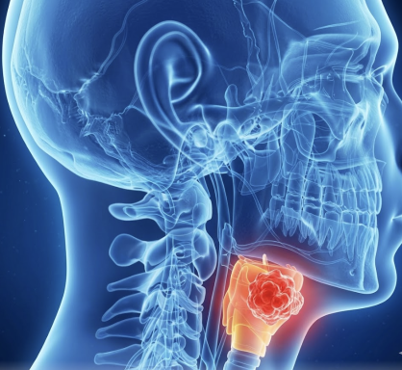
The larynx, commonly called the voice box, is a 2-inch structure in the front of your neck. You can feel it move when you swallow. Cancer here starts when normal cells lining the inside of the larynx begin growing out of control, forming a tumor that can invade nearby tissue or spread to lymph nodes in the neck.
What makes laryngeal cancer different from other throat cancers is its location. Because the vocal cords sit right in the middle of the larynx, even a small tumour on the cord changes how your voice sounds. That’s actually a lucky thing diagnostically. Glottic cancers, those on the vocal cords, tend to be detected earlier than cancers in other parts of the throat. Supraglottic cancers, above the cords, don’t affect the voice right away and often grow silently until they’re larger.
Laryngeal cancer accounts for approximately 20% of head and neck cancers worldwide. In India, it’s more common in men over 50, though younger patients with heavy tobacco exposure are showing up in clinics more often than a decade ago. Learn more about related conditions like hypopharyngeal cancer and nasopharyngeal cancer.
Symptoms of Laryngeal Cancer
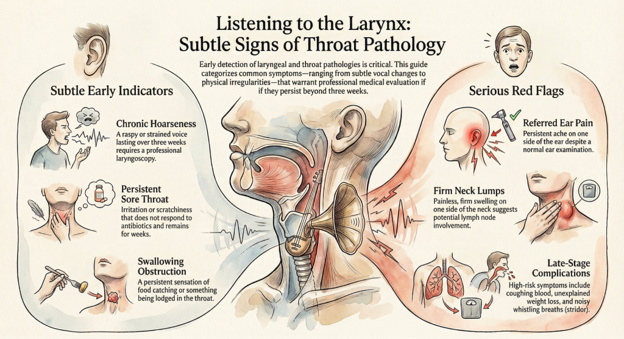
Symptoms depend almost entirely on where the tumour sits within the larynx. A glottic tumour will wreck your voice early. A supraglottic tumor might cause swallowing trouble first. A subglottic tumour, the rarest type, can grow for months before you notice anything.
Hoarseness:
The most common and often earliest sign. A raspy, breathy, or strained voice that lasts more than three weeks without improvement requires a laryngoscopy. Don’t chalk it up to allergies or a lingering cold.
Sore throat that won't quit:
Persistent irritation or a scratchy feeling that antibiotics can’t touch. It just sits there, week after week.
Trouble swallowing:
Food feels like it’s catching at the level of the throat. Some patients describe a sensation of something lodged in the throat, even when nothing is there.
One-sided ear pain:
Referred pain through shared nerve pathways. Your ear exam comes back normal, but the ache keeps returning.
Neck lump:
A painless, firm swelling on one side usually means lymph node involvement. This changes the picture significantly.
Breathing difficulty:
A tumour large enough to narrow the airway can cause stridor, a noisy, whistling sound during breathing. This is a late symptom.
Coughing blood:
Even small streaks in saliva or phlegm need urgent evaluation.
Unexplained weight loss:
Losing kilos without trying, combined with any of the above throat symptoms, is a serious red flag.
And here’s what catches people off guard. Every one of these symptoms mimics a benign condition. But benign problems resolve. Cancer doesn’t. Three weeks is the cutoff. Past that, stop guessing and get checked.
Need Assistance?
Are you experiencing any of these symptoms? Schedule an appointment with a trusted cancer specialist to promptly address your concerns.
Causes and Risk Factors of Laryngeal Cancer

There isn’t one single cause of laryngeal cancer. Instead, certain habits and exposures can increase your risk over time.
Tobacco use :
Tobacco use is the most important risk factor, whether it’s cigarettes, bidis, hookah, chewing tobacco, or gutka. These contain chemicals that damage the lining of the larynx, and the risk increases with longer and heavier use. Alcohol also contributes to risk. When combined with tobacco, the effect is not just additive; it significantly increases the likelihood of cancer.
Age and gender:
Age and gender influence risk patterns. Laryngeal cancer is more commonly seen in men over 55, but it can affect anyone. Human papillomavirus (HPV) infection is strongly linked to cancers of the throat (oropharynx), while its role in laryngeal cancer is less clearly established.
Certain workplace exposures
Certain workplace exposures can increase risk, particularly in people working in factories or construction. Long-term exposure to asbestos, wood dust, paint fumes, and industrial chemicals has been associated with a higher incidence.
Chronic acid reflux
Chronic acid reflux, known as Gastroesophageal reflux disease (GERD), may also play a role by causing repeated irritation of the larynx, although evidence is still evolving.
Additional contributing factors
Additional contributing factors include a family history of head and neck cancers and diets low in fruits and vegetables.
Overall, risk is highest when multiple factors, especially tobacco and alcohol, are present together.
Types of Laryngeal Cancer

Laryngeal cancer is classified by where in the larynx it originates. This matters because location determines symptoms, behaviour, and treatment approach.
Glottic cancer:
Starts on or near the vocal cords. This is the most common type. Because it affects the voice early, it tends to be diagnosed at an earlier stage. Prognosis is generally the best among the three types.
Subglottic cancer:
Starts below the vocal cords. The rarest type. It often presents late because it doesn’t disturb the voice or swallowing until it’s large enough to narrow the airway.
Supraglottic cancer:
Begins above the vocal cords, in the area that includes the epiglottis. It’s more likely to spread to the lymph nodes because the supraglottis has a richer lymphatic network. Symptoms such as difficulty swallowing or throat pain may appear before any voice change.
Most laryngeal cancers are squamous cell carcinomas. Rarely, other types such as adenocarcinomas, neuroendocrine tumours, or sarcomas can arise in the larynx, but these account for less than 5% of all cases.
Diagnosis of Laryngeal Cancer
Diagnosis can often be completed within a few days, depending on the tests required. Once you’re in front of the right specialist.
Flexible laryngoscopy:
A thin, flexible scope goes through the nose and down to the throat. It gives a direct, real-time view of the vocal cords and surrounding tissue. Takes about five minutes. This is always the first step for unexplained hoarseness.
CT scan or MRI:
Imaging maps the tumour’s size, depth, and whether it has invaded cartilage or nearby structures. CT is faster and better for bone detail. MRI is better for soft tissue definition.
Biopsy:
During endoscopy, a small tissue sample is taken and sent for histopathology. This confirms the cancer type and grade and guides treatment planning.
PET-CT scan:
Used for advanced cases to check whether cancer has spread beyond the neck to distant organs like lungs, liver, or bone.
Staging follows the TNM system. T describes tumour size, N describes lymph node involvement, and M indicates distant spread. Stages I and II are considered early. Stages III and IV are advanced. The stage drives the entire treatment plan.
Treatment Options for Laryngeal Cancer
Treatment depends on the stage, location, and the patient’s overall health. The goal is always the same: eliminate the cancer while preserving as much function as possible.
Early-stage (Stage I and II): Radiation therapy alone or transoral laser microsurgery (TLM) can cure the cancer while preserving the voice box. TORS (transoral robotic surgery) is another option for selected cases, allowing precise tumour removal through the mouth without external incisions. Dr. Sandeep Nayak pioneered several robotic approaches, including RABIT and RIA-MIND, that have made these procedures safer and less invasive.
Intermediate-stage (Stage III): May require partial laryngectomy, where part of the voice box is removed but enough is preserved to maintain some voice function. Alternatively, concurrent chemoradiation, which combines chemotherapy and radiation delivered together, can be used as an organ-preservation strategy.
Advanced-stage (Stage IV): Total laryngectomy, removing the entire voice box, may become necessary. The patient breathes through a permanent stoma in the neck afterward. Voice rehabilitation through speech therapy, electrolarynx devices, or tracheoesophageal puncture (TEP) helps patients communicate again. Reconstructive surgery using free tissue transfer may be needed to rebuild structures damaged during tumour removal.
At MACS, a multidisciplinary team, including surgical oncologists, radiation specialists, speech pathologists, reconstructive surgeons, and dental oncologists, collaborates on every case from the very first consultation.
Prevention and Risk Reduction
You can’t eliminate every risk factor. But you can knock out the biggest ones.
Quit tobacco. This is non-negotiable in every form. Quitting at any age reduces risk. It doesn’t reset to zero, but the numbers drop meaningfully year after year. Limit alcohol. If you drink, keep it moderate. If you also smoke, the urgency to quit both goes up sharply. Protect yourself at work. Wear proper masks and respiratory protection if you’re exposed to industrial dust, fumes, or chemicals. Eat well. A diet rich in fruits, vegetables, and antioxidants has been associated with a lower risk of head and neck cancer across multiple studies. Manage reflux. If you have chronic GERD, treat it. Ongoing acid exposure to the throat lining isn’t harmless.
And if you have any symptom that persists beyond three weeks, especially hoarseness, don’t wait for it to get worse. A five-minute laryngoscopy can rule out cancer or catch it early enough to cure.
Why Choose MACS Clinic
Dr. Sandeep Nayak has over two decades of experience in head and neck oncology and has developed pioneering robotic techniques such as RABIT, TORS, RIA-MIND, and PRIA, which are now being adopted by surgeons worldwide after training under him.
Patients at MACS aren’t shuffled between disconnected departments. Speech therapists, plastic surgeons, radiation oncologists, and dental specialists work as a single unit. Treatment plans are built around preserving your voice, your swallowing, and your quality of life, not just removing the tumour.
Need Assistance?
Looking to lower your risk of Laryngeal Cancer? Speak with a specialist for guidance on effective prevention strategies.
FAQs
What is the survival rate for laryngeal cancer?
Early-stage laryngeal cancer has 5-year survival rates between 85–95%, especially for glottic cancers.
Can you talk after laryngeal cancer surgery?
Yes, voice rehabilitation through speech therapy or TEP helps most patients communicate again.
Is laryngeal cancer the same as throat cancer?
Laryngeal cancer is one type of throat cancer, specifically affecting the voice box.
How fast does laryngeal cancer grow?
Glottic cancers tend to grow slowly, whereas supraglottic cancers can spread to lymph nodes more quickly.
Does acid reflux cause laryngeal cancer?
Chronic GERD is a suspected risk factor, though tobacco and alcohol carry far greater risk.
Can laryngeal cancer come back after treatment?
Recurrence is possible, which is why regular follow-up laryngoscopy is necessary for several years.