
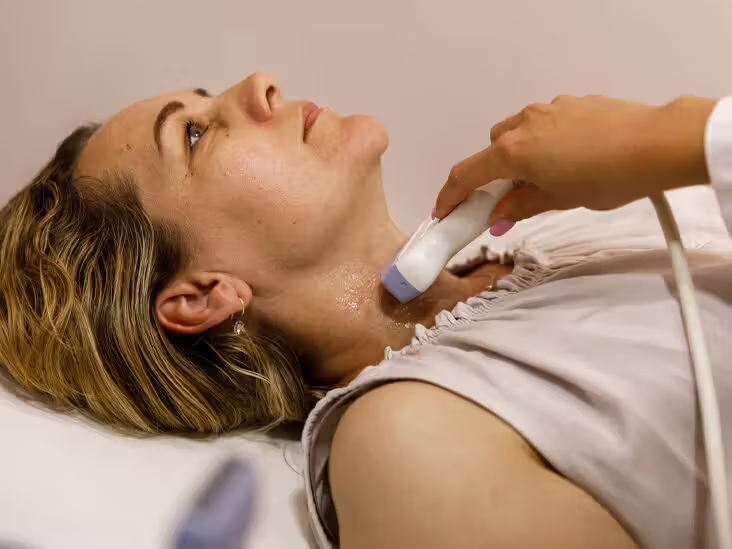
Curing thyroid cancer depends on removing part or all of the thyroid, because surgery is what reliably clears the disease. Keeping the gland is only an option for a narrow group of very small, low risk papillary cancers, which can be tracked through active surveillance instead of removed. Radioactive iodine and similar treatments support surgery rather than replace it. So going without removal stays the exception, never the default.
According to Dr. Sandeep Nayak, a Head and Neck Surgery specialist, “For most thyroid cancers, surgery is still the treatment that offers a real cure. Avoiding removal only makes sense in a narrow group of very low risk cases, and even then it means careful monitoring rather than a shortcut.”
Wondering if your case might avoid surgery?
When can thyroid cancer be managed without surgery?
Only a few specific situations let the gland stay in place, and all of them involve low risk disease.
- Tiny tumours : Very small papillary cancers under a centimetre can sometimes be monitored with regular scans instead of removed, as long as they aren’t growing or spreading.
- Active surveillance : This means tracking the cancer closely over time rather than treating it straight away, an approach kept for carefully selected low risk patients.
- Slow biology : Papillary thyroid cancer often grows so slowly that watching it carries little immediate danger in the right cases.
- Patient choice : Some people who can’t have surgery, or would rather not, choose monitoring after a frank talk about the trade offs.
So the answer isn’t a flat no, but it’s close. For the large majority, removal through something like scarless robotic thyroid surgery is still what clears the disease.
Why is surgery still the main cure for thyroid cancer?
For most cancers, taking the gland out gives the best chance of staying cancer free.
- Complete removal : Surgery physically takes out the tumour, which is the most reliable way to stop it spreading further.
- Staging : Examining the removed tissue shows exactly how far the cancer went, which guides any treatment that follows.
- Iodine therapy : Radioactive iodine works best once the thyroid is gone, since it can then target any cancer cells left behind.
- Recurrence : Leaving the gland in place keeps a small ongoing risk that the cancer returns or progresses unnoticed.
But removal doesn’t have to mean a visible scar these days. Our piece on whether scarless surgery is possible for thyroid cancer covers how that works.
Why choose Dr. Sandeep Nayak for thyroid cancer treatment?
Dr. Sandeep Nayak is a surgical oncologist in India and the surgeon who developed RABIT, and thyroid cancer is one of his core areas of work. Deciding whether a cancer truly needs surgery, or whether it’s safe to simply watch, takes experience across the full range of thyroid disease, because the line between low risk and not is easy to misjudge. That judgement matters more than any single technique.
For patients, that means an honest read on whether removal is necessary, and if it is, a route that clears the cancer while keeping recovery and appearance in mind. Which is the whole point of seeing someone who treats this often.
Call +91 9482202240 to book your consultation.
Frequently Asked Questions
Can thyroid cancer go away without surgery?
Rarely; most cases need surgery, though some tiny cancers are monitored instead.
What is active surveillance for thyroid cancer?
Watching a small, low risk cancer closely rather than removing it immediately.
Does radioactive iodine replace surgery?
No, it usually works after surgery, not instead of it.
Is surgery always needed for thyroid cancer?
Not always, but it remains the main cure for most cases.
References:
1.National Cancer Institute, Thyroid Cancer. https://www.cancer.gov/types/thyroid
2.Thyroidectomy, StatPearls, NCBI Bookshelf (NIH). https://www.ncbi.nlm.nih.gov/books/NBK563279/
Disclaimer:This article is for general information only and isn’t a substitute for advice from a qualified specialist.