
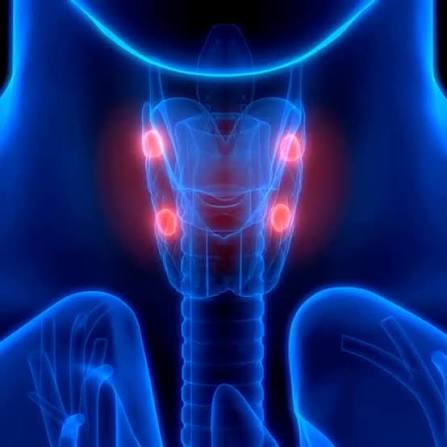
A parathyroid adenoma is a benign growth on one of the four parathyroid glands sitting behind the thyroid in the neck. It makes that gland pump out too much parathyroid hormone, and the extra hormone pulls calcium out of the bones and into the blood. Doctors call the resulting condition primary hyperparathyroidism. Most patients have just one adenoma, not four, which is good news, because removing that single gland cures the problem for good in the vast majority of cases.
According to Dr. Sandeep Nayak, a Head and Neck Surgery specialist, “Most patients don’t even know they’re carrying a parathyroid adenoma until a routine blood test flags high calcium. Once we confirm it on scan, removing that single gland is usually all it takes to fix things for good.”
Wondering if a parathyroid adenoma is behind your symptoms?
What causes a parathyroid adenoma, and how does it show up?
There’s no single trigger. A few patterns keep coming up in the patients we see.
Overactive gland tissue. This explains most cases. Roughly 85% of hyperparathyroidism comes down to one gland simply working overtime, for reasons that aren’t always obvious.
Genetic factors. These play a role for some people, though not the majority. A gene called cyclin D1 turns up altered in a fair number of sporadic adenomas. But most patients we test have no family history and no clear inherited cause at all.
Radiation exposure earlier in life. This is a factor too, especially exposure to the head and neck. It’s worth mentioning to your doctor even if it happened decades ago.
A slow, silent build-up. This condition can sit quietly for years. Fatigue, aching bones, kidney stones, and low mood creep in gradually, and a lot of patients only find out because a blood test ordered for something else entirely turned up high calcium.
We hear this constantly: people write off the tiredness as just getting older, when a five-minute blood test would’ve caught it years earlier. So if you’re dealing with an unexplained neck lump, or something like a thyroglossal cyst, get it looked at rather than sitting on it.
How is a parathyroid adenoma treated, and what's the recovery like?
Once it’s confirmed, treatment tends to follow a predictable path.
Surgery is the only real cure. Parathyroidectomy, removing the affected gland, works in around 95% of cases, and there isn’t really an equally effective non-surgical alternative.
Imaging comes first, always. A sestamibi scan or ultrasound tells the surgeon which of the four glands is enlarged, so the operation can target that one gland instead of exploring the whole neck.
The procedure itself is quick. Most minimally invasive parathyroidectomies wrap up in under an hour, through a small incision that heals with little scarring.
Recovery is fast in most cases. Patients usually go home the same day or the next, sometimes on short-term calcium supplements while the remaining glands adjust and start pulling their weight again.
A safety check is built right into the operating room. Surgeons recheck PTH levels mid-surgery, and if the level hasn’t dropped by more than half within minutes of removing the gland, that’s a signal to keep looking, since leaving a second overactive gland behind would defeat the purpose of the surgery.
We’ve written before about whether thyroid cancer can be cured without surgery, where the same question of when to operate and when to hold off comes up just as often. It’s this real-time feedback during parathyroid surgery that makes outcomes so consistent.
Why Choose Dr. Sandeep Nayak for Parathyroid Adenoma Treatment ?
Dr. Sandeep Nayak specializes in minimal access parathyroid surgery, built around precise preoperative localization rather than a routine neck exploration for every case. With hands-on experience in scarless and minimally invasive techniques, his team at MACS Clinic in Bangalore handles the full range, from a single-gland targeted approach guided by sestamibi and ultrasound imaging to more complex multigland disease. No guesswork, no unnecessary exploring.
Patients get an accurate read on which gland is involved before they’re ever on the operating table, and that precision is what keeps repeat surgeries rare. To discuss your case, call +91 9482202240.
Frequently Asked Questions
Is a parathyroid adenoma cancerous?
Not usually. It’s a benign growth, and true parathyroid cancer is uncommon, showing up in less than 1% of cases.
How do doctors find a parathyroid adenoma?
It usually starts with a blood test checking calcium and PTH levels, then an ultrasound or sestamibi scan to pinpoint the gland involved.
Do I need surgery for a parathyroid adenoma?
If it’s symptomatic or the calcium levels are significantly elevated, surgery is really the only option that resolves it for good.
How long does recovery take after parathyroidectomy?
Most people are back home within a day and back to their normal routine somewhere between one and two weeks later.
References:
- Parathyroid Adenoma, StatPearls (NCBI Bookshelf, NIH). https://www.ncbi.nlm.nih.gov/books/NBK507870/
- Primary Hyperparathyroidism, StatPearls (NCBI Bookshelf, NIH). https://www.ncbi.nlm.nih.gov/books/NBK441895/
Disclaimer:This article is for general information only and isn’t a substitute for advice from a qualified specialist.