
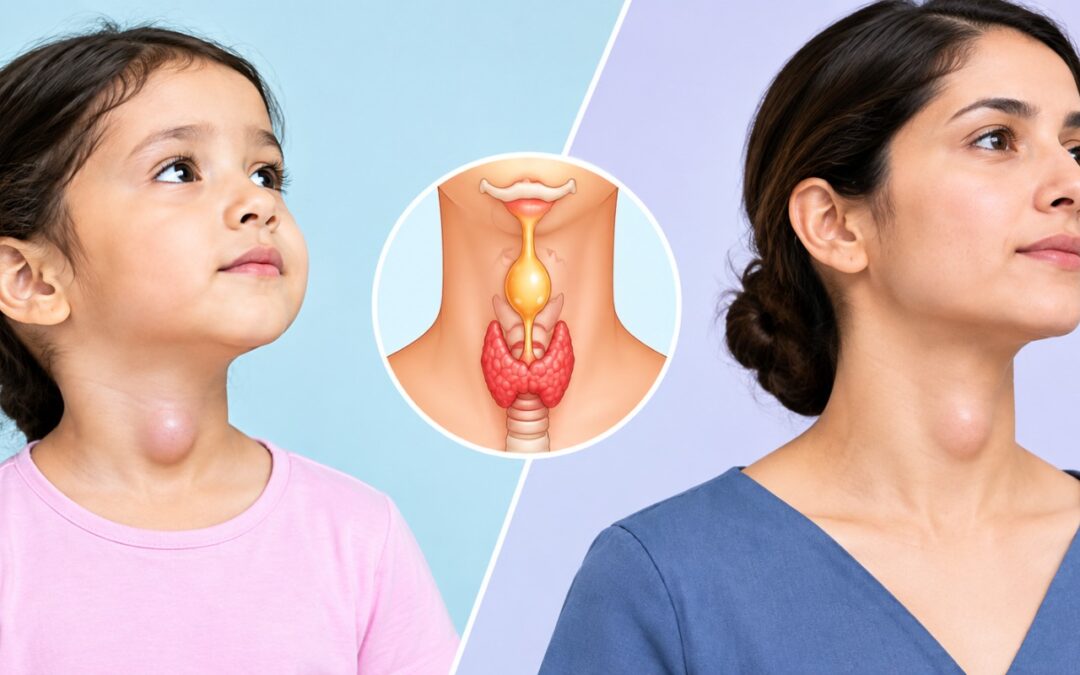
A thyroglossal cyst is one of the most common midline neck lumps doctors see, and it shows up in both children and adults. The good news is that the surgical approach doesn’t really change based on age. Whether the patient is 6 or 60, the standard operation removes the cyst itself, the middle portion of the hyoid bone, and the tract that connects them, a combination known as the Sistrunk procedure. What does shift between age groups is how the cyst tends to present and how it’s worked up beforehand.
According to Dr. Sandeep Nayak, a Head and Neck Surgery Specialist, “The Sistrunk procedure works the same way in a child or an adult, and that consistency is exactly why recurrence rates stay low across both groups. What changes is the workup beforehand, since adults tend to need a closer look before surgery than children do.”
Found a midline lump in the neck and unsure whether it needs treatment?
What Are the Symptoms of a Thyroglossal Cyst?
Symptoms look fairly alike whether the patient is a child or an adult, though age does shift a few things.
A painless midline lump: this is usually the first thing anyone notices, a smooth round swelling sitting in the center of the neck near or just below the hyoid bone.
Movement with swallowing: here’s a useful clue on exam. The lump rises when the patient swallows or sticks out their tongue, which is what separates it from other neck masses.
Infection or fistula: sometimes the cyst gets infected and starts draining, and this happens more in children than it does in adults.
Other complaints in adults:Besides the lump, adults tend to mention pain, trouble swallowing, or a voice change—symptoms kids rarely mention.
None of these symptoms confirm the diagnosis by themselves. A clinical exam and imaging at a centre offering thyroglossal duct cyst treatment is what actually settles it, whatever the patient’s age.
Does Thyroglossal Cyst Treatment Differ in Adults?
The core surgery stays the same, but there are a few real differences worth knowing about before treating a thyroglossal cyst in adults.
Pre-surgical evaluation runs a bit further. Adults more often get a thyroid ultrasound and sometimes a nuclear scan beforehand, mainly to rule out that the cyst is the patient’s only functioning thyroid tissue.
Cyst size tends to be larger. Cysts in adults are generally bigger than in children, and this can mean a slightly longer operation, though it doesn’t change the technique used.
Malignancy screening matters more. True cancer inside a thyroglossal cyst is rare in any age group, but pathology review after removal is still standard practice, especially in adults presenting later in life.
Recovery and recurrence rates hold steady. Studies comparing children and adults consistently show no significant difference in recurrence after a properly performed Sistrunk procedure.
The same principle used in diagnosing a parathyroid adenoma applies here too: a thorough workup before surgery, regardless of the patient’s age, is what keeps outcomes consistent.
Why Choose Dr. Sandeep Nayak for Thyroglossal Cyst Treatment?
Dr. Sandeep Nayak performs the Sistrunk procedure with close attention to removing the full tract and hyoid segment, since that’s really what keeps recurrence low in both children and adult. Every case gets worked up properly beforehand to rule out an ectopic thyroid or another midline mass before surgery is planned.
Patients know their diagnosis and treatment plan well before surgery day arrives. Call +91 9482202240 to discuss your case.
Frequently Asked Questions
Is thyroglossal cyst treatment different for children and adults?
Not really. The surgery is the same; the workup beforehand changes a bit.
What is the standard treatment for a thyroglossal cyst?
The Sistrunk procedure, which takes out the cyst, tract, and hyoid segment together.
Can a thyroglossal cyst come back after surgery?
Not often, under 8% typically, as long as the whole tract comes out.
Is a thyroglossal cyst ever cancerous?
Very rarely. Malignancy shows up in under 1% of cases.
References:
- Management of Thyroglossal Cyst in Adults: A Single-Institution Experience, PMC (NIH): https://pmc.ncbi.nlm.nih.gov/articles/PMC8112365/
- Thyroglossal cysts in a pediatric population: apparent differences from adult thyroglossal cysts, PMC (NIH): https://pmc.ncbi.nlm.nih.gov/articles/PMC6078570/
Disclaimer: This blog is for educational purposes only. It’s not a diagnosis. If you notice a midline neck lump, consult a specialist for evaluation.