
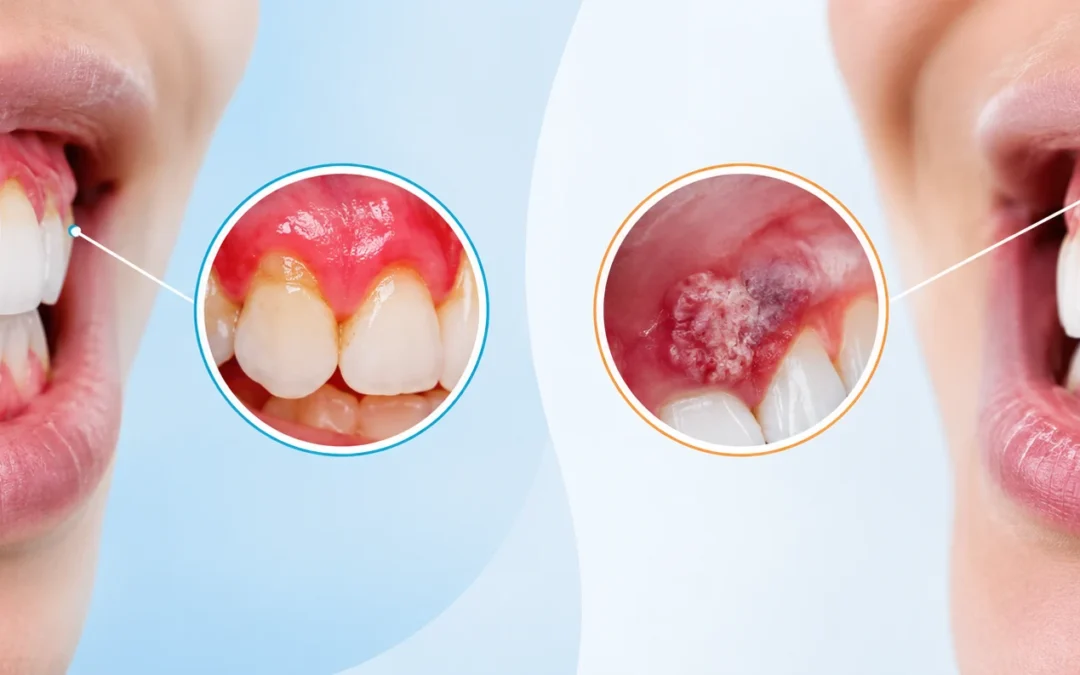
Bleeding, swollen gums usually point to plain old gum disease, and most people have dealt with some version of it. Gum cancer looks different. It tends to show up as one stubborn spot, a sore, lump, or patch that sticks around no matter how well you brush and floss. Knowing which one you’re dealing with matters, since the two get treated in completely different ways.
According to Dr. Sandeep Nayak, a Head and Neck Surgery Specialist, “Gum disease is usually widespread and responds to better oral hygiene within a couple of weeks. A cancerous lesion doesn’t. It stays in one spot, doesn’t improve with cleaning, and that’s the detail patients and even some dentists miss early on.”
Not sure if that stubborn gum patch is disease or something more serious?
What Are the Symptoms of Gum Cancer?
Gum cancer symptoms can look deceptively mild at first, which is exactly why they get missed.
A sore that won’t heal: unlike a typical mouth ulcer, a cancerous gum lesion sticks around past three weeks regardless of how well oral hygiene is maintained.
A lump or thickened patch: firmness or swelling localized to one area of the gum, rather than spread across the gumline, is a pattern worth flagging.
A red or white patch: patches that look different in color or texture from surrounding gum tissue, and don’t resolve with cleaning, need a closer look.
Loose teeth without obvious cause: gum cancer can affect the underlying bone, and this sometimes shows up as tooth mobility with no clear dental explanation.
None of these symptoms confirm cancer by themselves. A proper exam and biopsy at a centre offering tongue cancer treatment is what actually settles it.
Gum Cancer vs Gum Disease: What Actually Sets Them Apart?
The distinction usually comes down to pattern, not just appearance.
|
Feature |
Gum Disease |
Gum Cancer |
|
Spread |
Affects the gums broadly and evenly |
Stays confined to a single, specific spot |
|
Response to hygiene |
Improves noticeably with better brushing, flossing, and a professional cleaning |
Shows no such improvement |
|
Bleeding pattern |
Bleeds easily and often during brushing |
Bleeding tends to be more sporadic and localized to the lesion |
|
Pain |
Usually uncomfortable early on |
Frequently painless, especially in early stages |
This overlap between benign-looking symptoms and something more serious is the same reason a tongue ulcer that won’t heal deserves the same scrutiny. Anything localized and non-healing in the mouth, gum or tongue, is worth checking rather than waiting out.
Why Choose Dr. Sandeep Nayak for Gum Cancer Treatment?
Dr. Sandeep Nayak brings over two decades of experience in head and neck surgical oncology, with fellowship training in minimal access surgery and a faculty background at Kidwai Cancer Institute. He now leads India’s first Fellowship in Minimal Access Surgical Oncology and evaluates suspicious gum lesions with a proper biopsy rather than treating them as routine periodontal disease by default.
Patients get an early, honest read on what they’re actually dealing with, before it has a chance to progress further. To discuss your case, call +91 9482202240.
Frequently Asked Questions
How is gum cancer different from gum disease?
Gum disease is widespread and improves with hygiene; gum cancer doesn’t.
What does gum cancer look like in its early stages?
Often a localized sore, lump, or red/white patch that won’t heal.
Can gum disease turn into gum cancer?
No, they’re separate conditions, though both can coexist in the mouth.
When should a gum sore be checked by a specialist?
If it persists beyond three weeks despite good oral hygiene.
References:
- Gingival Squamous Cell Carcinoma: Diagnostic Challenges and Clinical Implications, PMC (NIH): https://pmc.ncbi.nlm.nih.gov/articles/PMC13144544/
- Gingival squamous cell carcinoma mimicking as a desquamative lesion, PMC (NIH): https://pmc.ncbi.nlm.nih.gov/articles/PMC4795141/
Disclaimer: This blog is for educational purposes only. It’s not a diagnosis. If a gum sore or patch persists, consult a specialist for evaluation.