
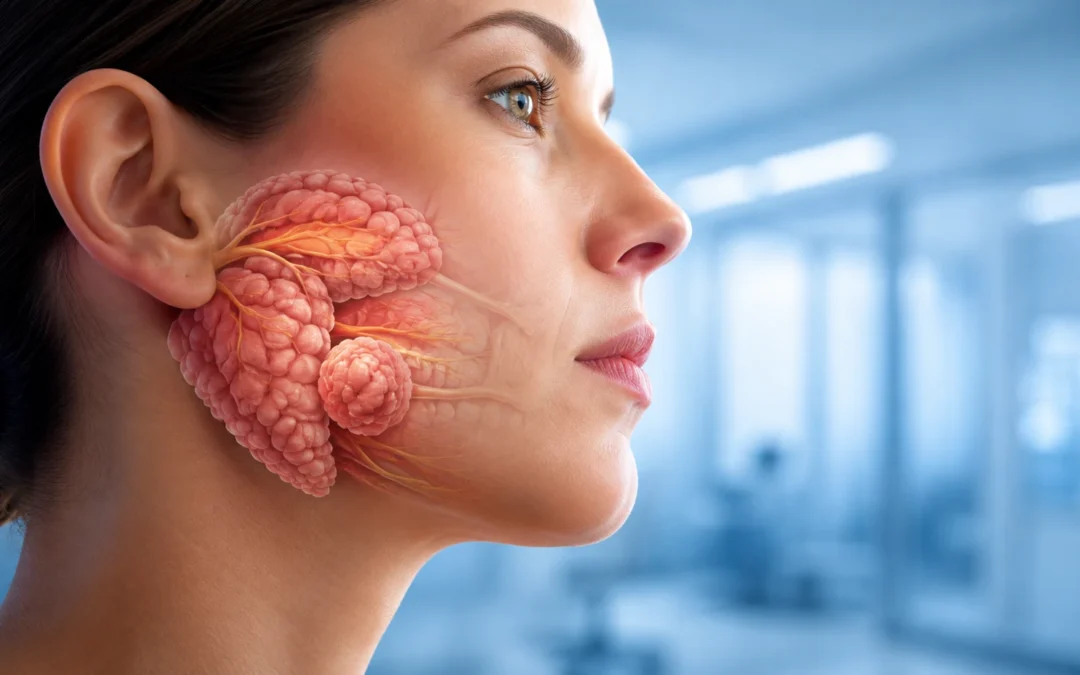
A lump near the ear or jaw usually raises one question first: is it cancer? For salivary gland tumours, the odds are actually reassuring. Around four out of every five turn out to be benign, growing slowly and staying confined to the gland. The rest can be malignant, which is exactly why any new swelling in this area deserves a proper look rather than a guess.
According to Dr. Sandeep Nayak, a Head and Neck Surgery Specialist, “Most salivary gland tumours are benign. That said, the type, the size, and which gland is involved all change how we approach it. Imaging and a needle biopsy usually give us a clear answer before surgery is even on the table.”
Noticed a lump near your jaw or in front of your ear?
What Are the Symptoms of a Salivary Gland Tumor?
A salivary gland tumour doesn’t always announce itself early. A few patterns tend to show up first though.
A painless lump: Most people notice a slow swelling near the ear, jaw, or under the tongue before anything else. It rarely hurts at this stage. That’s part of why it gets brushed off.
Facial nerve changes: Numbness or weakness on one side of the face isn’t something benign tumours usually cause. So when it shows up, it tends to point toward malignancy.
Trouble swallowing or opening the mouth: This one creeps up gradually. Larger tumours, or ones sitting deep in the gland, can restrict jaw movement, and swallowing gets harder in small steps rather than overnight.
A shift in growth pattern: Sudden growth. Skin that feels tethered to the lump. New pain where there wasn’t any before. Any of these moves it past the “just watch it” stage.
None of this confirms anything by itself. A clinical exam and imaging at a centre offering salivary gland tumour treatment is what actually settles it.
How Do Doctors Tell a Benign Salivary Gland Tumor From a Cancerous One?
Symptoms alone rarely give a clean answer. But a short diagnostic sequence usually does.
Imaging first: An ultrasound or MRI maps the tumour’s size and location and checks whether the borders look smooth or irregular. That already tells a doctor a fair amount about what the tumour might be like.
Fine needle aspiration: A thin needle draws a small sample of tissue for cytology. One step, and in most cases that’s enough to answer the benign-versus-malignant question outright.
Which gland is involved matters too: Parotid tumours tend to be benign more often than not. Tumours in the smaller salivary glands carry a higher risk of being malignant.
Confirmation once it’s removed: Even after a clean needle biopsy, whatever comes out during surgery still goes to pathology. That’s the step that actually closes the loop.
The same principle used for diagnosing a parathyroid adenoma applies here. Image first. Confirm before deciding on surgery, not after.
Why Choose Dr. Sandeep Nayak for Salivary Gland Tumor Treatment?
Dr. Sandeep Nayak specializes in minimal access salivary gland surgery, with hands-on experience in parotidectomy and other techniques built around protecting the facial nerve. Every case at his clinic in Bangalore goes through imaging and needle aspiration before a surgical plan is even finalised. No guesswork. No rushed calls.
Patients get a clear read on whether a lump is benign or something that needs closer attention long before surgery is planned. To discuss your case, call +91 9482202240.
Frequently Asked Questions
Are most salivary gland tumors cancerous?
No. Most are benign; roughly one in five turns out malignant.
What is the first sign of a salivary gland tumor?
Usually a slow-growing, painless lump near the ear or jaw.
How is a salivary gland tumor diagnosed?
Imaging plus a needle biopsy, confirmed by pathology after surgery.
Does a benign salivary gland tumor need surgery?
Often, yes. Even benign tumours can recur or keep growing.
References:
- Benign Salivary Gland Tumors, StatPearls (NCBI Bookshelf, NIH): https://www.ncbi.nlm.nih.gov/books/NBK564295/
- Parotid Cancer, StatPearls (NCBI Bookshelf, NIH): https://www.ncbi.nlm.nih.gov/books/NBK538340/
Disclaimer: This blog is for educational purposes only. It’s not a diagnosis. If you notice a persistent lump near your jaw or ear, consult a specialist.